You looked up the price of a visual identity and ended up more confused than before.
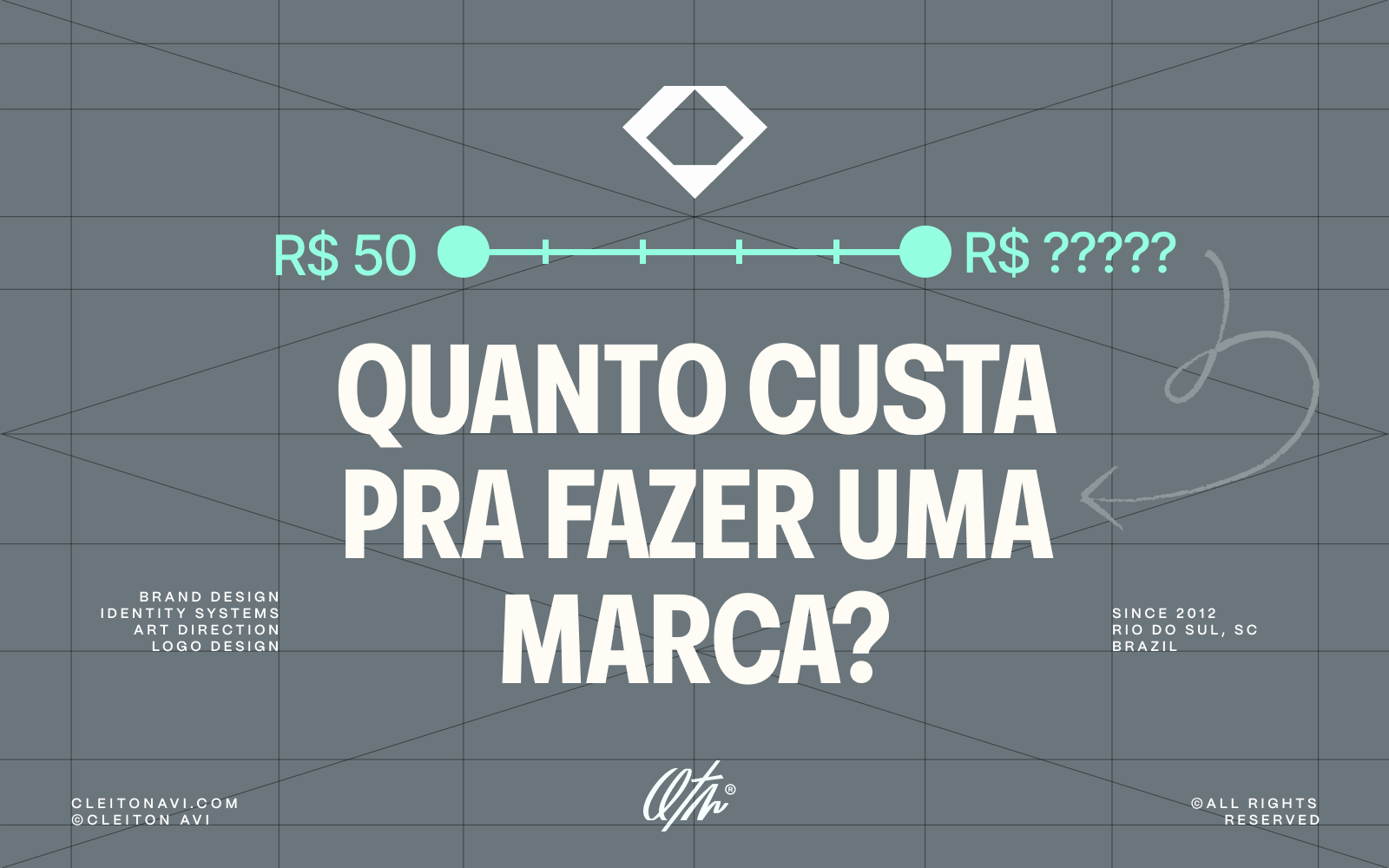
You found logos for R$50. You found projects for R$50,000. And, in between, every possible number, for a service with the same name. How do you decide when the price difference reaches a thousand times?
The good news is that this variation isn’t random. It follows a clear logic, and once you understand that logic, you stop comparing prices and start comparing what is being delivered. That’s what this text will give you.
How much does a visual identity cost? The short answer
A visual identity costs anywhere from a few hundred reais to more than half a million, depending on two things: the depth of the work and who does it.
At the bottom, you buy a drawing. At the top, you buy strategy, research, a system and the experience of someone who has solved the same problem dozens of times. That’s why there’s only one rule before asking for a quote: compare the scope, never just the number. Two quotes with the same value can deliver completely different things.
The ranges the market charges
These are the ranges charged in Brazil, based on market surveys from 2025 and 2026. They work as a reference, and what changes from one to the next is always the size and depth of the work.
Ready-made logos and templates, from R$50 to R$400. Logo marketplaces, stock templates and automatic generators. You get a generic drawing, with no real customization and no business decision behind it. It solves an emergency, and nothing more.
Beginner freelancers, from R$800 to R$2,500. A logo with simple variations, a palette and basic typography. No robust system and no strategy. It works for an early-stage business that just needs to exist visually.
Experienced freelancers and small studios, from R$2,500 to R$8,000. A logo in several versions, palette, typography, applications and a working manual. This range serves most small and mid-sized companies that already have clients and want to professionalize their brand.
Specialized studios, from R$8,000 to R$80,000 or more. Here comes what makes the real difference: research, positioning, visual territory, a complete system and advanced guidelines. This is the range for companies expanding, rebranding or launching that need the brand to match the level of the operation.
Large branding agencies, from R$100,000 to R$500,000 or more. A multidisciplinary team, competitive pitches, extensive strategy and the structure to follow the brand over time. This is the level of companies with the budget and ambition for large-scale branding.
The values here are a snapshot of the Brazilian market, based on public surveys and my own experience. They vary by region and by professional, and they change over time, so they work as a reference rather than a price list.
Notice what happens when you see the whole spectrum. The R$50 template and the half-million agency are selling different things. They sit at opposite ends of depth.
What makes the price vary
Four things explain why two visual identity quotes are so different.
- The first is depth. A standalone logo is one thing. A complete visual system, with rules and applications, is another. And an identity built from strategy and positioning is yet another. Each of these layers adds work, and adds to the price.
- The second is the experience of the person doing it. A professional with years of portfolio and projects for real companies charges more than a recent graduate. The difference lies in the ability to understand the business, anticipate problems and deliver a strategic result, well beyond a pretty drawing.
- The third is research and positioning. More expensive projects start before the drawing, with immersion in the business and a definition of who the brand talks to. That invisible work is what makes the visuals hit the mark instead of guessing.
- The fourth is the size of the delivery. How many logo versions, how many applications, a short or advanced manual, materials for how many touchpoints. More scope, higher price.
Why the cheapest option ends up expensive
The lowest range looks like savings, but most of the time it’s a trap. The savings show up at the time of purchase, but further down the road three bills arrive:
The first is differentiation. A template logo, one from an automatic generator or one made by artificial intelligence delivers a generic drawing, often similar to those of other companies that bought the same template. It doesn’t differentiate and doesn’t support value. It works while the business is small. When it grows, the brand starts to clash with the level of the operation, you redo everything from scratch and pay twice for what you could have done once.

The second is finishing. Many of these cheap logos arrive as a flat image, a PNG or a JPG, without the editable vector file. In practice, it’s a logo that loses quality when enlarged, turns into a blur on a storefront or billboard, has no version for dark backgrounds or small sizes, and doesn’t work for large print, embroidery or a printed pattern. Logos made by artificial intelligence hide the same problem: they look finished on screen, but have crooked strokes, messy curves and a construction no professional would approve when opening the file. A clean, well-built vector, with every version and format, is precisely part of what you pay for when you hire a professional.

The third, and the most ignored, is legal. When you get a logo from a stock site or marketplace, most of the time you only receive a limited usage license, without real ownership of the drawing. The same template may have been sold to dozens of other companies, and you have no exclusivity over your own brand. Add to that the risk of plagiarism: fonts used without a commercial license, elements copied from elsewhere, or a drawing too similar to a competitor’s. All of this leaves you exposed to having to change your logo overnight and, worse, makes it hard or impossible to register the trademark with INPI, Brazil’s trademark office. A generic or copied brand is hard to register and almost impossible to defend. An original, well-made brand is an asset you protect and nobody else can use in your place.
The cheap option works as a temporary fix. The problem is that it rarely keeps up with the business’s future, and sometimes it creates a problem that didn’t even exist before.
Which price range makes sense for your business
The right range depends on your business’s moment. Each of the price ranges I listed above serves a different situation.
If the business is small, local, with little competition and doesn’t depend on standing out to sell, the lowest range may do the job for now. A neighborhood bakery or a service that lives on referrals doesn’t need, at first, a robust visual system to work. The same goes for businesses that are just starting and haven’t validated their offer yet: something more affordable can help validate the product before really investing in a brand.
If you already have clients, already bill and your brand today looks amateur compared to what the company really is, the intermediate or strategic range is where the investment pays off. It’s the moment when the image needs to reach the level of the operation, so it stops making you look smaller than you are.
And if you’re going to scale, raise investment or enter a more demanding market, it makes sense to look at work with strategy and a complete system. That’s when the brand starts working as a business asset.
In the end, the right range is the one that can handle what your company will demand from the brand in the coming years. Thinking only about what fits today usually ends up expensive later.
Frequently asked questions
Why are two visual identity quotes so different? Because the price reflects more than a list of deliverables. It follows the depth of the work, the experience of the person leading it and the weight the brand carries in that business. Visual identity has no fixed price list, because it deals with perceived value, and that changes from company to company. That’s why a serious quote only comes after understanding your case.
What’s the price difference between a freelancer and an agency? A freelancer usually costs less and gives you a direct relationship with the person doing the work. An agency costs more and offers team structure and continuity. The right value depends on the size of your project and how much the brand weighs in your business.
Is a cheap visual identity worth it? To validate an idea at the very beginning, sometimes. But weigh the cost of redoing it later. If you already believe in the business, investing from the start makes the brand stick in people’s memory sooner, and that recognition works in your favor for longer. The cheap option usually charges the difference later, in consistency, differentiation and rework.
How long does a visual identity project take? In-depth work usually takes four to eight weeks, depending on the scope and the pace of feedback. Bigger projects, led by large agencies, can take four to eight months. Very fast deliveries generally skip the strategy stage, which is what makes the result work.
How much would yours cost
Now you know the whole market, from the R$50 template to the six-figure agency. My work sits in the range of those who deliver strategy and a complete system, the point where the visual identity stops being a drawing and starts supporting the value of the business.
Every quote is put together for your case, never from a fixed price list, because the fair price depends on what your brand needs to carry. And it’s designed to give you back more than it costs: a brand that charges more, attracts the right client and keeps up with the company’s growth.
I’ve worked in design since 2012 and specialized in visual identity and brand building. Tell me what moment your business is in, and I’ll show you what would make sense for it.
If you’re still unsure whether it’s time, see when investing in visual identity is worth it.